


 home
home contact
 site map
 my account


|
| |||
 |
|
 |
VIP Task Manager |


|
| |||
|
|
|
VIP Task Manager |
|
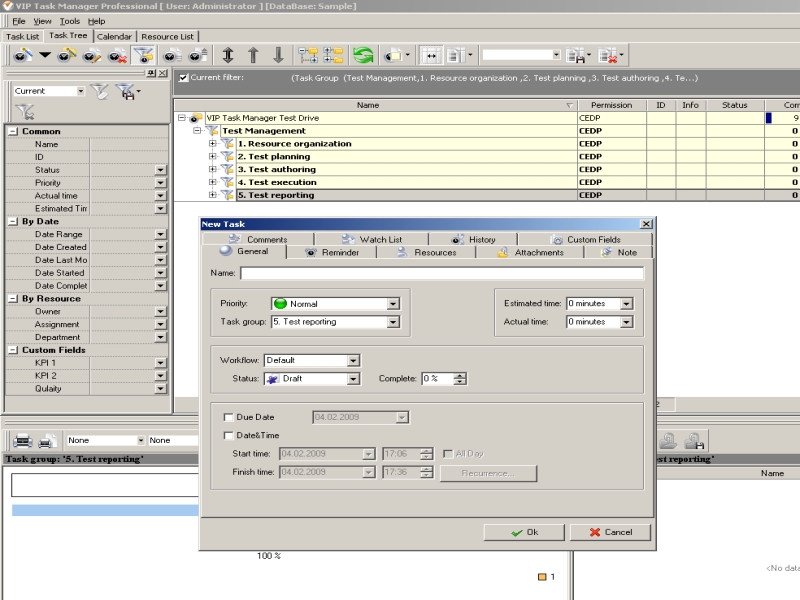
Maintaining and controlling a product quality is the ultimate goal of any company, especially software development company, which intends to satisfy customer needs and win a victory over rivals. Test management is the way to control a product quality and make product development smoother and more efficient. Companies organise Test Departments and Quality Assurance Departments trying to reduce defects, track metrics, collaborate with team and avoid mistakes within the development process. Test management can be broken into several phases, such as follows: | ||
|
||
 |
|
|
The testing efforts will generate a lot of information. From this information, metrics can be set, and the team leader can measure and track quality goals for the project. Then, the quality metrics will be used for identifying the project success or failure VIP Task Manager is a flexible test management system which lets organizations manage their test teams more efficiently. This featured client/server software provides transparent management of quality cycles, including resource management, department management, test case management, team collaboration, defect management, test execution, document management and most aspects of task reporting and performance metrics in real time.VIP Task Manager makes it easy to manage the entire testing life cycle by splitting it into phases and to-do lists. Testers can create test cases and attach test results directly to tasks. This helps them run test cases rapidly and update the results in real time. Read also a new article about process management - project management client-server software for Windows |
||

 Play Demo
 Play Demo
|
| |||
|
|
|
VIP Task Manager |

 home
home contact
 site map
 my account