Task Management Software


New Articles New Articles RSS feed subscribe
 
Setting Dependencies between Sub-projects
Sub-projects are smaller, interrelated projects that compose larger projects. If sub-projects belong to one and the same project or programme, they are dependent upon each other in some way. Setting Dependencies between Sub-projects


New Checklists News RSS feed subscribe
 
Company Expenses Action Plan

Read this Company Expenses Action Plan to find out what kinds of expenses your small company is likely to generate.

Company Expenses Action Plan


Home » Solutions » Collaboration
Desktop collaboration tools vs. Online collaboration tools  

Desktop collaboration tools vs. Online collaboration tools


Collaboration is a working practice when a group of individuals work together to achieve common goals and derive business benefits. Collaboration is an essential and integral part of management. When you need to organize a group of people into a productive team to manage common projects, collaboration will help. To establish and support collaboration, you will need to apply special collaboration software tools which can be divided into two types: desktop collaboration tool and online collaboration tool. Let’s review each of the types in detail.

Desktop collaboration tools
Any office today uses personal computers and desktop software to organize work. Desktop collaboration tools offer technologies that enable employees to effectively collaborate internally or externally in real time. Usually such tools establish user collaboration through Local Area Network (LAN), but Internet connection is also supported. Desktop collaboration tools allow sharing information between employees and managing to-do lists, schedules, documents and files. Usually these tools are used by small- and mid-size teams.

Main features of desktop collaboration tools are:

  • Managing tasks, schedules and projects
  • Support of both LAN and Internet connection
  • Storing files, documents and other information in local/remote databases
  • Password-protected access to local/remote databases

Main benefits from using desktop collaboration tools are:

  • No regular fees and necessary payments for collaboration services
  • No need to use Internet browsers and online resources
  • Possibility to collaborate securely within an office
  • Organizing real time chats and discussions and getting immediate feedback from users

There are both commercial and free desktop collaboration programs. Commercial editions are more popular as they give users secure, reliable and featured functionality, regular updates, and sufficient tech support services. Free desktop collaboration programs often include less featured functionality and built-in advertising modules, have no regular updates, and sometimes even contain spyware.

Online collaboration tools
When you need to coordinate online meetings, participate in video conferences, and plan webinars, online collaboration tools will help. These tools offer web-based services to allow users collaborating and communicating with each other, organizing teamwork, managing tasks, and sharing information. Multiple online collaboration tools reviews and demonstrations prove high efficiency of web-based solutions. For example, Google online collaboration tools and Microsoft online collaboration tools give excellent opportunities to establish user collaboration.

At the same time, if you read an adequate online collaboration tools comparison, you will notice that any online/web-based solution is supported by stable Internet connection only, gives not convenient possibility to collaborate locally, and requires regular payments and fees for collaboration services.

Main features of online collaboration tools are:

  • Managing tasks, schedules and projects
  • Support of Internet connection and use of web browsers to access remote resources
  • Storing files, documents and other information in remote databases
  • Password-protected access to remote databases

Main benefits from using online collaboration tools are:

  • Remote access to files and documents (it’s convenient for those users who don’t want to or just cannot keep information locally)
  • Possibility to create a corporate network of documents, tasks and files (usually it’s a benefit for large companies and corporations only)
  • Organizing webinars, video conferences and online chat sessions (usually this benefit is supported by the best online collaboration tools only)

There are both free and commercial online collaboration tools. Usually, online collaboration tools free web solutions give limited functionality to manage simple tasks, create to-do lists, and share information. Sometimes they are referred to online collaboration tools open source solutions. Commercial online collaboration tools offer great functionality which costs monthly fees per user per account name.

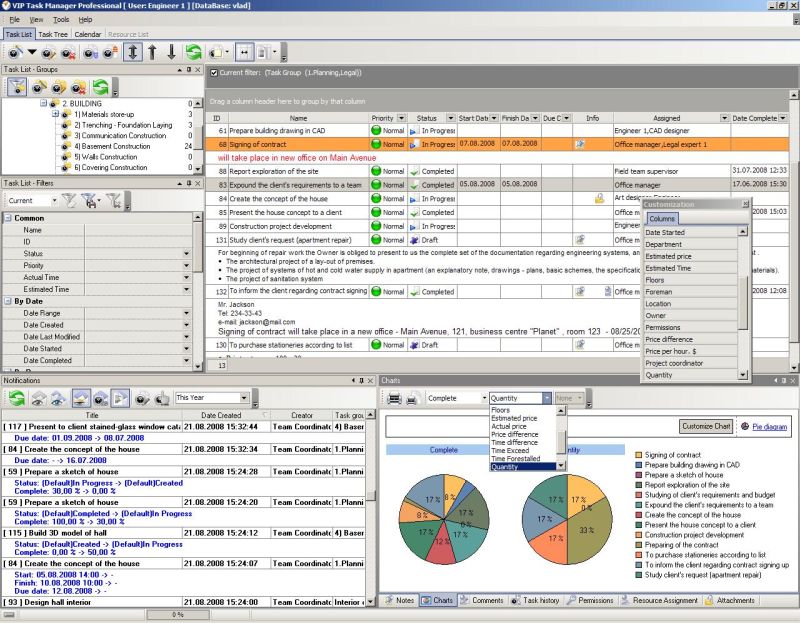
VIP Task Manager is a desktop collaboration tool that gives you a set of task management solutions to create, manage, track and report tasks, schedules and projects. The software is based on a client-server technology allowing users to collaborate and communicate with each other in real time through LAN and/or Internet.VIP Task Manager has a 30-day trial copy you can download from this website.

VIP Task Manager
Task management software
for teams & small offices
Play Demo / Download

CentriQS
Business management software
for small & midsize enterprises

Play Demo / Download


home contact site map my account


Copyright © 2004 - 2012 VIP Quality Software, Ltd. All Rights Reserved.