Project management KPI(s) are quantifiable measurements that reflect and measure achievements on critical success factors of the project. Key success factors are vital areas where project critically needs to output good results in order to prosper. Actually, we can give a dozens of KPI examples from every project area including quality, risks, production, sales, finances, etc. Everything depends on the scale, scope and character of the project, meaning that every area of project management may have its own KPI characterizing and measuring its success. Specific KPI(s) can be applied to different processes on each of the major steps in order to evaluate and qualify their products and ongoing activities. Let’s consider these project’s elements where PIs can be used:
- activities – all the essential activities and processes performed on the project for the sake of its administering, technical operation, execution, maintenance, and also all the possible specific activities and processes driving the project towards practical completion – all of them can be measured and controlled via current KPIs monitoring to define how successfully these activities are performed, so that if any defections are indicated, the immediate remedial steps along with ongoing preventive re-forming can be applied.
|
- deliverables – all of the project’s intermediate outputs and results need to be properly controlled to ensure their compliance with predefined success criteria referring to qualitative and quantitative traits (success of each process or outcome can be described with dozens of attributes, but the those criteria method refers to the really critical parameters). Actually pre-planned value of specific KPI(s) here are considered as desired goals and they are compared against actually obtained results.
- stages – every stage of project performance can be connected with a set of its essential KPI(s) which express desired objectives that the project needs to meet within its critical success areas and factors. Such measurements can be designed to track and review all the project management key points (milestones, stages and deliverables) where certain targets should be attained.
- competencies – it is necessary to evaluate how well people on the project undertake their roles and perform their direct duties. KPIs are the way to measure and evaluate performance of the persons engaged into your project. If you (as a supervisor) and your subordinates have a shared clear picture of what objectives you need to achieve together, it would be much easier for you to reach these results as increased awareness increases the level efforts as well as.
|

 Play Demo Play Demo
|
Some simplest KPI examples can be the following:
- For production: number of defective products created against number of normal ones, per certain period.
- For sales: number of prospects turned into actual sales against overall number of prospects, per certain period.
- For HR: actual time used for finding and employing an appropriate candidate against estimate time allocated for this process.
|
Software for working with key performance indicators:
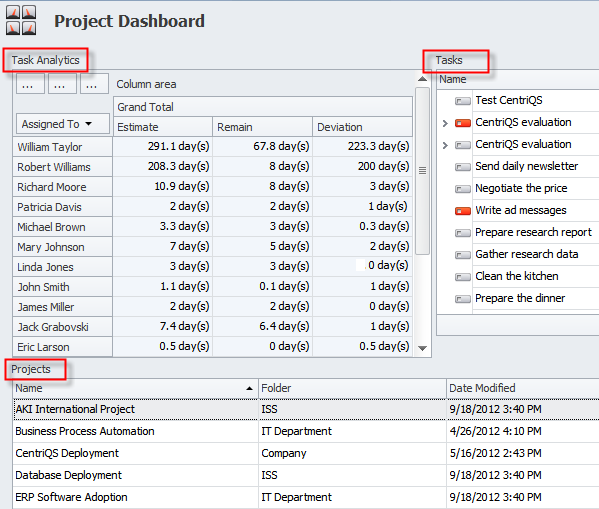
There are different project management products that provide special tools (dashboards) for establishing control over KPIs to have them all at one place. KPI dashboard is an electronic panel where the project manager can see and control all the key performance indicators related to his project. These indicators can be derived from several key elements (areas) concurrently, so that project manager can have an in-depth report on everything happening on the supervised project. Good specific example of such a tool is CentriQS that is a product supporting sample project management KPIs in tasks- and time-oriented manner, where people can control all the processes and tasks within one database. |
|
| |
|
|


 home
home contact
 site map
 my account


 Play Demo




 home
home contact
 site map
 my account